


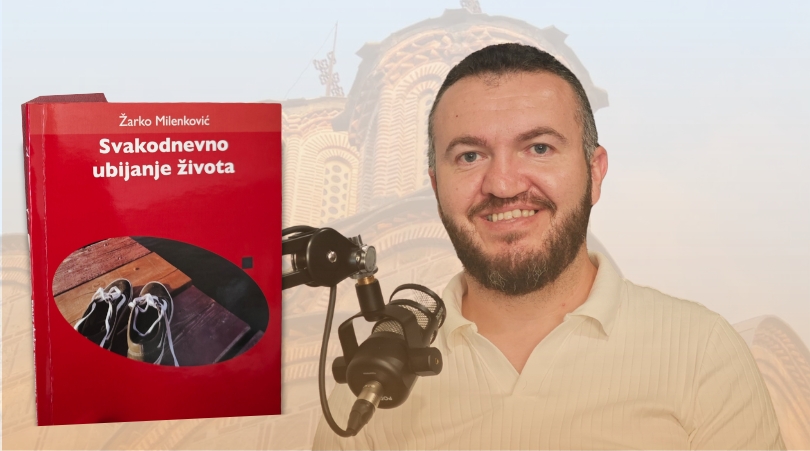
In the latest episode of the “How Is It Down There?” podcast, we spoke with Žarko Milenković, a poet, literary critic, and editor at the Gračanica Cultural Center.
Although the conversation began with the upcoming Vidovdan celebrations, it quickly expanded into something much deeper: what everyday life in Kosovo and Metohija looks like, what it means to create art in Gračanica, how people preserve their dignity despite uncertainty, and why staying is about much more than making a personal choice.
How is it down there?
When asked the question that inspired the podcast’s title, Žarko admits that people often ask, “How is it down there?”—but they don’t always have the patience to hear the real answer.
“Everything that is abnormal has become normal for us, and then the challenge is finding a way to explain it so that others can truly understand.”
Life here cannot be summed up in a single sentence. It is difficult to describe what it’s like when the electricity goes out, when there is no water, when even going to the grocery store can feel uncomfortable, or when someone harasses you simply because you do not speak their language.
And yet, beyond the headlines, there is something that rarely gets noticed: perseverance, endurance, dignity, and faith that life still has meaning.
Vidovdan in Kosovo and Metohija – The Crown of Life and Creativity
For Žarko, Vidovdan is much more than a date on the calendar. It represents both the cultural and identity foundation of the Serbian people.
“Vidovdan is, for us, not only an identity marker but also a cultural one.”
The Vidovdan Celebrations in Gračanica are the culmination of a year’s work by the Gračanica Cultural Center and an opportunity to show that Kosovo and Metohija are not only places of suffering, but also places where culture continues to thrive.
“The Vidovdan celebrations are the crown of everything we have worked on throughout the year.”
They remind us that books are still being written, exhibitions organized, films produced, plays performed, music composed, and poetry created. Culture here is not a relic of the past—it is a living part of everyday life.
Kosovo Is More Than an Epic Story
One of the most important topics of the conversation was the difference between how Kosovo is described by those who live there and those who observe it from afar.
Žarko explains that, from the inside, Kosovo is not experienced only as an epic symbol. For the people who live here, it is first and foremost about everyday life, love, patience, waiting, and ordinary moments
“Kosovo is lyrical. Kosovo is the very essence of everything.”
That is why, he says, it is important not to speak of Kosovo only as a place worth dying for, but as a place worth living in.
“We must live for Kosovo, not die for it.”
This shift in perspective changes everything. Staying is not a slogan—it is the daily decision to live, work, create, and preserve what has been entrusted to us.
Culture as a Window to the World
Žarko also spoke about his book Everyday Killing of Life, written during the COVID-19 pandemic, yet deeply shaped by the much longer experience of isolation, fear, and uncertainty that many Serbs in Kosovo and Metohija have lived with since 1999.
“This is the most personal book I have ever written, and in many ways it became a form of self-healing.”
For him, creativity is a way to break free from confinement and to bring light into both personal and collective darkness through words.
“Literature is always searching for that small ray of light that leads out of the darkness.”
In that sense, culture is not merely an addition to life it is one of the ways life is preserved. Through books, poetry, art, theatre, and cultural events, the Serbian community in Kosovo and Metohija continues to show that it is still here and that its identity is far greater than any political issue.
Gračanica, Priština, and Lost Cities
One of the most moving moments of the conversation focused on Priština, Žarko’s hometown—a city that is geographically close but emotionally and spiritually distant.
He describes watching the city lights from his room every evening while carrying the feeling that the city where Serbs once lived, created, and built their lives has become disconnected from their present reality.
“We are so close, yet in truth it feels so far away.”
That sentence reflects not only the relationship with Priština, but also the experience of many Serbs in Kosovo and Metohija: physically close to their hometowns, monasteries, and land, yet often separated from what belongs to them through birth, memory, and culture.
Staying as a Mission
When asked why he chooses to stay, Žarko offers no simple answer. He says there were never many prospects before, and there are none now in the conventional sense. Yet what keeps people in Kosovo and Metohija often goes beyond logic and personal calculation.
“We cannot fully explain why we are still here.”
Still, there is a deeper meaning behind that decision.
“None of us can be saved alone—we survive as a community.”
Staying is therefore also a responsibility toward those who came before us, those who live here today, and those who will come after us.
Vidovdan as a Celebration of Life
The conversation also emphasizes that Vidovdan is not only about remembering sacrifice—it is also about affirming life. The Kosovo Covenant is a call to meaning, dignity, and faithfulness.
That is why the Vidovdan Celebrations in Gračanica carry such special significance. They bear witness to the fact that, despite everything, something has endured, something has been renewed, and something continues to be created here.
“Something survived. Something came together again. Something created once more and continues to create today.”
Perhaps that is the most important message of this conversation: Kosovo and Metohija are not only places of pain, but also places of creativity. They are not only the past—they are also the present. They are not only about survival, but about life itself.
You can watch the entire episode of the podcast “How’s it going down there” with Žarko Milenković on the channel How is it down there?
You Can Support Our Work
Monthly (ongoing) subscription
Help us continue our humanitarian work and support families in Kosovo and Metohija. By becoming a monthly donor, you become part of our everyday mission to provide hope and assistance to those who need it most. Subscribe
One-Time Donation
If you would like to support our work without a monthly commitment, you can make a one-time donation and directly contribute to our humanitarian projects. DONATIONS











Оставите коментар