


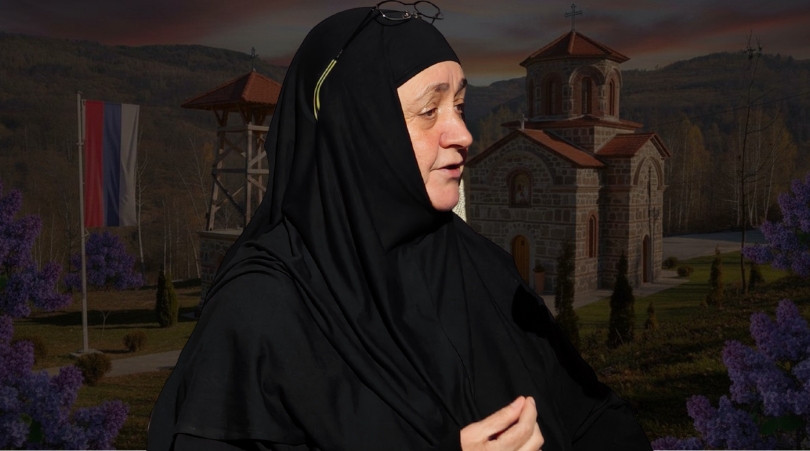
In the first episode of the podcast “How Is It Down There?”, we spoke with Mother Stefanida, the abbess of the Monastery of Saint George in Brnjak, about life in Kosovo and Metohija, fear, pain, home, children, and the hope that, despite everything, still shines in the eyes of those who love Kosovo.
The question “How is it down there?” is one that Serbs from Kosovo and Metohija hear often. It carries curiosity, concern, sometimes fear, and often the helplessness of those trying to understand the everyday life of people who live there.
Mother Stefanida does not answer with lamentation, nor does she try to beautify reality. Her response is simple, calm, and profound:
“Thank God, we are well. We endure.”
But behind those few words lies much more. A life that continues. A prayer that sustains people. A nation that suffers. Children who grow up. Monasteries that bear witness. Homes that, despite everything, are not abandoned.
There is no fear in Kosovo, but there is pain
Speaking about her arrival in Kosovo and Metohija, Mother Stefanida points out something that may sound unexpected to many who observe Kosovo from afar:
“And most importantly, there is no fear.”
She shares that before coming to Kosovo, she herself felt anxiety whenever passing through this region. But once she came to live there, the fear disappeared.
“The first thing that disappeared, the first miracle from God, was fear. There is no fear, no anxiety. We sleep peacefully, we function, we do everything as if we live in peace.”
Life in Kosovo and Metohija, she says, is not a life of constant fear. People go to the store, work, travel, and carry out daily tasks. But what hurts is not personal hardship — it is the suffering of the people around you.
“What hurts is what you witness. You feel the pain of the people beside you.”
Perhaps this sentence best describes what it means to live in Kosovo and Metohija. A person does not carry only their own life. They also carry the fears, injustices, and uncertainties of others — the pain of mothers, children, families, and an entire nation.
“You suffer because of what other children, our children, are going through — because of the anxiety and uncertainty in which our people live.”
Home is not just a place — it is belonging
One of the most beautiful parts of the conversation was about the meaning of home. Mother Stefanida spoke about searching for a place where a person truly belongs, about the inner feeling of home, and about what it means to build a home again in Kosovo and Metohija.
“Where is my home? Where do I belong?”
As she explains, this question followed her since childhood. Home is not merely a house or a point on a map. Home is the place where a person feels they truly belong, where they can give of themselves and build something meaningful.
“You can only be truly happy and at peace in your own home.”
For Mother Stefanida, that feeling of home was inseparable from her encounter with God. When she found God, she also found her home.
“You cannot find yourself without God, nor can you find your home.”
After many years spent in the Monastery of Saint Prohor of Pčinja, coming to Brnjak meant starting over. Not an easy beginning, not a comfortable one, nor outwardly secure. But inwardly — without fear.
“We are starting from the beginning again. I am older now, there is no health, no youth, but there is absolutely no uncertainty in my soul — only complete peace.”
That peace, independent of external circumstances, is one of the strongest messages of this conversation. In Kosovo and Metohija, home is often built not from abundance, but from faith, belonging, and the decision to remain where one is called to stay.
“It is not about the place itself. It is about the inner feeling, the certainty that you belong there and that this is where you build yourself, your home, and your community.”
The Kosovo Mother and the Words: “We Will Endure”
One of the most emotional parts of the conversation concerns the strength of Kosovo mothers. Mother Stefanida speaks about a woman whose son was sentenced to life imprisonment a mother carrying the unbearable weight of the word life sentence.
That word alone life sentence is enough to break a mother.”
Yet it is in women like her that Mother Stefanida sees a strength beyond ordinary human endurance. When dark thoughts come, that mother takes the Psalter and reads until the heaviness lifts.
“I read, and read, and read, until those thoughts leave me.”
Afterward, she says, the mother can once again lift her head and say: he is alive, the children can still see him, they still have their father — we will endure.
“I raise my head and move forward.”
There are no grand slogans in those words. Only life. Only faith. Only what is quietly passed down among the Serbian people in Kosovo and Metohija: that one must endure — not for some distant idea, but for children, home, ancestors, faith, and the future.
“Where does she find such strength? That kind of strength can only come from God.”
Why Young People Cry When They Come to Kosovo
Mother Stefanida also speaks about young people who visit Kosovo and Metohija, tour monasteries, hear stories of suffering, and often cry without fully understanding why.
“They come — I saw it in Gračanica and here in Brnjak as well… You speak to them about frescoes, and tears begin to fall. You tell them about the harvesters, and tears begin to fall.”
Those tears are not merely emotional reactions. They are an encounter with the depth of Kosovo. With pain that has not ended. With history that still lives beyond the pages of books. With sacrifice that still breathes through the people, the holy sites, the fields, the mothers, and the children.
Mother Stefanida especially mentions the harvesters of Staro Gracko:
“They went out to harvest their own fields, and there they were cut down. That harvest took them too.”
And then she adds a sentence that carries both the tragedy and the hope of Kosovo:
“The harvesters were cut down, the wheat was cut down — yet the Serbs still sow their fields.”
That is Kosovo and Metohija: pain and sowing. Graves and children. Monasteries and schoolyards. Suffering and a life that refuses to disappear.
The Kosovo Covenant as a Way of Life
In this conversation, the Kosovo Covenant is not presented as a distant historical concept, but as a way of life. Not something merely read about, but something deeply felt in Kosovo.
“This is our Kosovo Covenant. That choice of Prince Lazar, which we read about on paper, but here in Kosovo we truly live it.”
That covenant is passed on not only through words, but through life itself — through endurance, decisions, staying, prayer, and love for what belongs to us.
“Alongside all the suffering and uncertainty of life in Kosovo, you also feel the divine inspiration that comes from sacrifice. You feel that God is there. You feel that God is with us.”
That is why Mother Stefanida believes the suffering of our people is not meaningless.
“It is a seed that remains in future generations and serves as a guide.”
And that guide is not only for great historical moments. It is also for everyday life — for the moments when a person chooses whether to retreat or remain, whether to forget or remember, whether to think only of themselves or also carry the burden of another.
If We Forget, We Lose Ourselves
One of the most important questions in the conversation was: what happens if we renounce Kosovo, its sacrifice, and the Kosovo Covenant?
Mother Stefanida’s answer is clear:
“It is enough to forget.”
Forgetfulness, she says, is not a small thing. It is not merely a break with the past, but the loss of the future as well.
“We are not only rejecting our history, our families, our roots, and everything rich within the history of our people. By rejecting all of that, we are also rejecting our future — and worst of all, we are rejecting our own identity.”
A people who forget their sacrifice, their holy places, their mothers, their graves, and their children cease to know who they are. That is why memory in Kosovo and Metohija is more than remembrance — it is a way of survival.
The Beauty of Kosovo in the Eyes of a Child
At the end of the conversation came a question that remains both a prayer and a hope: will our children preserve the beauty of Kosovo within themselves?
“Will they remember the rosy dawns of Metohija? Will their eyes preserve the greenery of the Kosovo plain?”
Mother Stefanida answers:
“I am certain they will.”
And she continues:
Видим да у тој деци има соли, има соли, има наде.
And that is perhaps the deepest message of the entire conversation. Kosovo and Metohija are not preserved only in documents, books, or grand speeches. They are preserved in the eyes of a child who has seen Gračanica. In the tears of a young man hearing for the first time the story of the harvesters. In a mother reading the Psalter. In a nun building a home from the beginning. In a family that stays. In children who will one day know how to say: this is our home.
“I firmly believe there is hope, and that there are those who will preserve the apple of our eye.”
And as long as there are children who carry Kosovo within themselves, as long as there are those who come, cry, pray, remember, and return — there is hope.
“The image of Kosovo’s beauty will remain in the eyes of our child, our children.”
You can watch the full episode here: here
The podcast How Is It Down There? and the work of our organization can be supported in the following ways:
Monthly Subscription
Support our humanitarian actions and help families in Kosovo and Metohija. By choosing a monthly subscription, you become part of our everyday mission of support. Subscribe here
One-Time Donation
If you would like to support our work without a monthly commitment, you can make a one-time donation and directly help our initiatives. Donations









Оставите коментар