


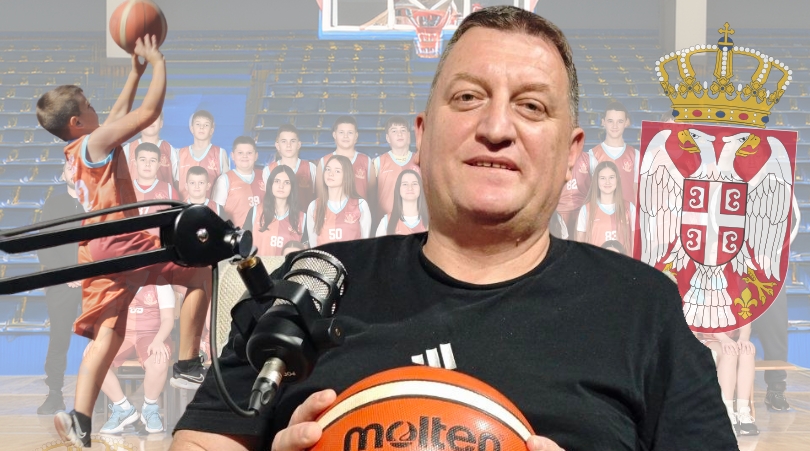
In a new episode of the podcast “How Is It Down There?”, we spoke with Ivan Arsić, a physical education teacher, basketball coach, and father of four. For more than twenty years, he has worked with children in Kosovo Pomoravlje, and today he leads KK Kosovo Pomoravlje, the only Serbian basketball club south of the Ibar River.
The conversation was about much more than basketball. It was a discussion about childhood in Serbian communities across Kosovo and Metohija, villages with fewer and fewer children, and sport as a space for connection, personal growth, and freedom.
Children Growing Up with Limited Freedom
Speaking about the conditions in which children are growing up today, Ivan points out that many young people in Kosovo Pomoravlje experience a lack of freedom—the freedom to move around, socialize, and enjoy life the way their peers do in larger communities.
“The children who live here grow up in these circumstances. Some call them ghettos, others call them enclaves, but you can definitely feel that lack of freedom.”
In many villages, only a handful of children remain. As a result, mobile phones often replace playgrounds, streets, and friendships.
“In those villages where only a few children are left, their friends are mobile phones.”
That is precisely why sports here are not just about training sessions. They are opportunities for children to step out of isolation, meet their peers, travel, and feel like part of a team.
Sport as a School of Life
For Ivan Arsić, basketball is much more than a game. It teaches children how to handle victory and defeat, develop discipline and patience, and find their place within a community.
“Basketball is like life. We never know what will happen a month from now.”
Through sports, children learn that mistakes are not failures but opportunities to grow. They learn that victory should never humiliate an opponent and that defeat should never break a person.
“Through sports, we teach children that mistakes are necessary for growth.”
In communities where organized activities are limited, every practice session matters. Every tournament becomes an event. Every trip beyond the village is an experience that leaves a lasting impression.
A Club That Is Always the Visitor
One of the greatest challenges facing KK Kosovo Pomoravlje is that the club cannot play home games in its own community. Instead, home matches must be played in central Serbia.
“We cannot play as hosts here in Kosovo and Metohija. We have to play in central Serbia, which means we are always the visitors.”
As a result, children rarely have the chance to play in front of their parents, grandparents, classmates, and friends. What is considered normal for most clubs becomes a significant logistical and financial challenge for this one.
Despite that, the children keep going. They train, travel, compete, gain valuable experience, and continue building a team that has become an important part of life for Serbian children in Kosovo Pomoravlje.
Girls Who Became a Team
A special part of the conversation focused on the club’s girls’ team. Ivan spoke proudly about the girls who have distinguished themselves through hard work, responsibility, and mutual support.
“This group is incredibly united. These girls truly function as a team.”
They arrive at practice together, encourage one another, and celebrate each other’s successes. When one of them leaves, it is not just a roster change—it is a farewell felt by the entire group.
“Even if they do not become top athletes, they will become genuinely good people. I can guarantee that.”
Perhaps that is the club’s greatest achievement—not the score on the scoreboard, but the children who become more responsible, confident, and connected through sport.
Life in Kosovo and Metohija: Between Thorns and Water
When speaking about life in Kosovo Pomoravlje, Ivan does not romanticize reality, but neither does he reduce it to hardship alone. His description perhaps captures the complexity of life in Kosovo and Metohija better than anything else.
“Life in Kosovo and Metohija is like walking on thorns—and sometimes walking on water.”
In that one sentence lies both hardship and blessing, struggle and meaning.
“Perhaps this is a privileged place to live—Kosovo and Metohija.”
For children growing up here, life includes farewells, limitations, long journeys, and uncertainty. But it also offers a strong sense of belonging—to family, village, team, Church, and homeland.
What the Club Needs to Continue
For KK Kosovo Pomoravlje to continue its work, stable support is essential—not occasional assistance, but long-term backing that allows the club to plan practices, transportation, equipment, and competitions.
“We need systemic solutions: organized transportation and a general sponsor willing to commit for a longer period, so we can rely on stable finances.”
Many children have already passed through the club’s programs, and around ninety currently train there. For some, basketball may become a sporting career. For many others, it will remain a treasured memory of childhood, friendship, and belonging.
Basketball as a Reason to Stay
KK Kosovo Pomoravlje is not just a sports club. It is one of the ways children in Serbian communities south of the Ibar River can have structure, goals, teammates, travel opportunities, mentors, friendships, and a reason to believe they can build a future where they are.
In a place where every departure is difficult, every return matters, and every gathering is precious, a single basketball, a single practice, and a single team can mean far more than outsiders might imagine.
You can watch the full episode of the podcast “How’s It Down There” with Ivan Arsić on the channel How’s It Down There.
Support the work of the “Kosovsko Pomoravlje” Club and help children south of the Ibar River have their own club, their own team, and their own place to grow up.
You can support our work in the following ways:
Monthly (ongoing) subscription
Support our initiatives and help families in Kosovo and Metohija. Join our mission to provide a dignified life for Serbian communities and become part of our everyday work of support. Subscribe.
One-Time Donation
If you would like to support our work without committing to a monthly subscription, you can make a one-time donation and directly contribute to our humanitarian activities. DONATIONS












Оставите коментар