


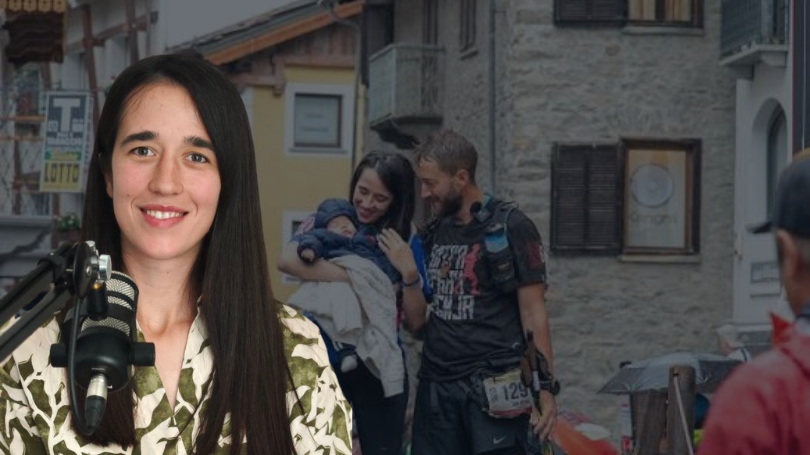
For Milica Božović Daničić, Kosovo and Metohija is more than just the homeland she returns to. It is a place of family roots, living faith, and values she hopes to pass on to her children. In the podcast “How Are Things Down There?”, she spoke about growing up, motherhood, family, and her hope that future generations will return to the land of their ancestors.
Born in Priština and raised in Ibarski Kolašin and Kosovska Mitrovica, Milica Božović Daničić continued her education in Belgrade, where she graduated from medical school. Today, she is the wife of ultrarunner Dalibor Daničić and the mother of two boys, Zarija and Isidor.
Although she lives in Belgrade, her connection to Kosovo and Metohija has never been broken. Her parents and much of her extended family have remained in their homeland, where they continue to live, work, and cultivate their land.
When asked how things are down there, Milica gives a simple answer, quoting the Gospel:
Come and see.
“Mum, Can You See That Light in the Sky?”
Speaking about how her children experience Kosovo and Metohija, Milica shared one of the most touching moments from their family life.
Because of work commitments, the family had been visiting Kosovo less often, so she asked her older son, Zarija, whether he would like to visit his grandparents. At first, he said he would rather stay and play with his friends. But when she explained that his grandma and grandpa lived in Kosovo, the little boy stood up and said:
“Mum, can you see that light shining in the sky over there? Well, that’s where Kosovo is.”
In this simple sentence, spoken by a child, lies everything Milica is trying to pass on to her children: a love for their homeland that is not imposed, but grows naturally through visits, family stories, and shared experiences.
A Return That Begins with Family
Milica speaks with pride about her parents and relatives who have remained in Kosovo and Metohija. She particularly points out that she has never heard her parents talk about building a life somewhere else.
Their example played an important role in shaping her childhood and outlook on life.
During the conversation, she also shared her hope that one day one of her children might wish to return and continue the family’s life in Kosovo and Metohija.
“So that it doesn’t all remain just a song, but becomes a real return.”
She said this while speaking about the need for love of one’s homeland to find practical expression, too.
She was particularly moved by the story of a friend who, after many years, visited Kosovo again and decided to buy a field, even though he had no immediate financial need for it.
For Milica, gestures like these show that sometimes it is through returning and reconnecting with people that we rediscover our deeper bond with the land of our ancestors.
Growing Up Surrounded by Family, Music, and Faith
Milica fondly remembers her education in Kosovska Mitrovica, where she attended both grammar school and music school.
The hours spent practising the piano, studying, and keeping up with daily responsibilities taught her discipline and perseverance – qualities that later helped her throughout her medical studies.
Although playing the piano gradually took a back seat in her life, she does not believe that all the effort she invested in music was in vain.
Growing Up Surrounded by Family, Music, and Faith
Family stories, faith, and an awareness of her ancestors were also an important part of her upbringing. She believes children should get to know real people and historical events that can serve as examples and inspiration in their own lives.
Motherhood Does Not Mean Giving Up on Yourself
In her conversation with Marija Vasić, Milica also spoke openly about marriage, motherhood, and the expectations placed on women in modern society.
She particularly highlighted how mothers today can feel overwhelmed by the constant advice they receive about raising children, child development, and the pressure to plan and organise every aspect of family life in advance.
In her experience, parenthood requires effort and responsibility, but also more spontaneity, trust, and joy.
Speaking about motherhood, she also recalled the idea that a mother is not called to care only for her own child, but to extend her love and care to other children as well.
A Community Where Children and Parents Grow Together
The ultrarunning community, built around her husband Dalibor, holds a special place in the Daničić family’s life.
Milica talks about training sessions, travels, friendships, and people from different professions and generations who come together around shared values.
For her, one of the greatest strengths of this community is that children are not separated from the world of adults. On the contrary, they take part in shared activities, spend time with their parents, and grow up surrounded by people who support one another.
At a time when families often struggle to find enough time to spend together, Milica sees this way of life as an opportunity to build closer relationships and a genuine sense of togetherness.
Her story reminds us that love for Kosovo and Metohija is passed down not only through words and grand promises. It is passed on through visits to grandparents, working the family land, songs, prayers, and childhood memories.
And sometimes, all it takes is for a little boy to look up at the sky and recognise Kosovo in its light.
Watch the full conversation with Milica Božović Daničić in the podcast.„How are things down there“.
You can support our work in the following ways:
Monthly (fixed) subscription
Support our initiatives and help families in Kosovo and Metohija! We invite you to join us in the struggle for a dignified life for Serbs in Kosovo and Metohija.
Choose a monthly subscription and become part of our ongoing, day-to-day mission of support. Subscribe
One-time donation
If you would like to support our work without the commitment of a monthly subscription, you can make a one-time donation and directly assist our initiatives. DONATIONS









Оставите коментар