


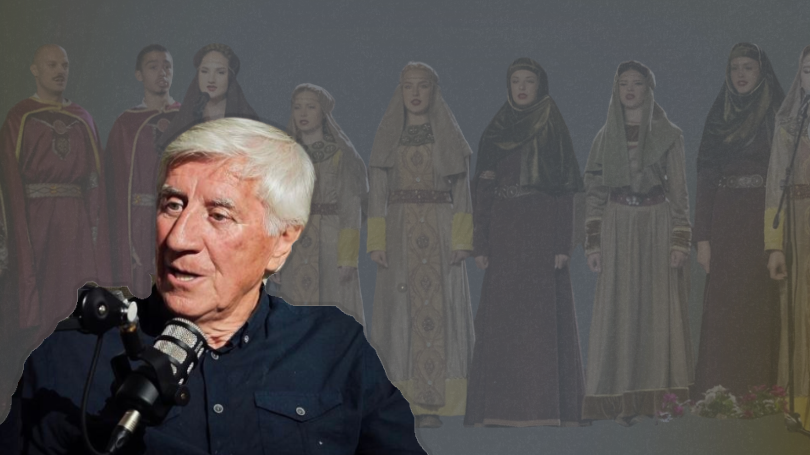
At a time when Serbs were being forced to leave their homes in Kosovo and Metohija, Đorđe Lakušić was travelling from village to village, documenting forgotten songs and dances and rescuing traditional folk costumes. In the podcast “How Are Things Down There?”, he spoke about his decades-long work, his commitment to preserving Serbian culture, and his responsibility towards future generations.
Đorđe Lakušić, Cultural Director of the “Kopaonik” Cultural and Artistic Society from Leposavić and a folk dance choreographer, has been involved in folklore since 1974. His work has gone far beyond the stage and traditional dancing. He has devoted decades to researching, documenting, and preserving the cultural heritage of Serbs from Kosovo and Metohija.
In a conversation with Marija Vasić, he reminded listeners that folklore is not simply entertainment, but a way for a people to preserve their identity.
When Folklore Becomes a Struggle for Survival
Folklore is more than just dance
With these words, Lakušić explained how traditional songs, customs, and dances pass down the values of a family, a region, and an entire people.
He spoke in particular about growing up and working during a time when, as he recalled, Serbian culture was not given the space and recognition it deserved.
In 1998, he accepted an invitation to work with the “Kopaonik” Cultural and Artistic Society in Leposavić, on the condition that its activities would not be limited to local folklore alone. His goal was to encompass the whole of Kosovo and Metohija.
Soon afterwards came the war, displacement, and the disappearance of entire Serbian communities from certain villages and towns.
At that moment, I realised that if we did not preserve something, we would soon have no one left to talk to about those places
Lakušić recalls.
Rescuing Traditional Folk Costumes During the Most Difficult Years
One of the most memorable parts of the conversation focused on the efforts to save traditional Serbian folk costumes after 1999.
Lakušić described how he collected and rescued traditional costumes from the Sredačka Župa region and the Prizren area, at a time when many families were being displaced and belongings from their homes were being sold or taken away.
His research took him through numerous villages, often under extremely difficult conditions. Yet, as he explained, he was never afraid.
I knew what we were doing. I knew I was not alone. I felt that I was part of a mission and that we had to see it through
He particularly emphasised that every locality has its own distinctive features and that a researcher’s task is to preserve precisely that diversity.
Some locations required between two and three and a half years of fieldwork.
Eighteen Localities Preserved in Books
The results of this work were presented in the book “Return to the Source”, which documents 18 localities across Kosovo and Metohija.
Lakušić also spoke about another book dedicated to Serbian traditional folk costumes from the second half of the 19th century and the first half of the 20th century.
Thanks to a workshop specialising in the making of traditional folk costumes and cooperation with museum institutions, costumes from the researched regions were reconstructed.
Film and digital materials were also produced to make this heritage accessible to people around the world.
Culture is something that requires you to give your whole self to it, to dedicate yourself completely. A rehearsal is like a liturgy
Children Must Understand What They Dance and Sing
A specific part of the conversation was dedicated to children, young people, and the responsibility of those who teach them folklore.
Lakušić believes that learning the steps and the melody is not enough. A child must understand the lyrics of a song, its origins, and the meaning behind the customs it represents.
The key is to truly understand what you are dancing, what you are singing, and all the messages being conveyed
he pointed out.
He also spoke about seminars for young folk dancers and the importance of bringing them together. His hope is that new generations will become more than just performers – they should also be knowledgeable about and committed to protecting their own heritage.
For Đorđe Lakušić, preserving Serbian culture in Kosovo and Metohija is not a task that ends with the publication of a book or a performance on stage. It is a responsibility towards those who lived in this region before us, but also towards the children who are yet to discover the richness of the heritage they have inherited
Watch the full conversation with Đorđe Lakušić in the podcast „How are things down there“.
You can support our work in the following ways
Monthly (Recurring) Subscription
Support our initiatives and help families in Kosovo and Metohija! We invite you to join us in the struggle for a dignified life for Serbs in Kosovo and Metohija.
Choose a monthly subscription and become part of our ongoing, day-to-day mission of support. Subscribe
One-Time Donation
If you would like to support our work without the commitment of a monthly subscription, you can make a one-time donation and directly assist our initiatives. DONATIONS












Оставите коментар