


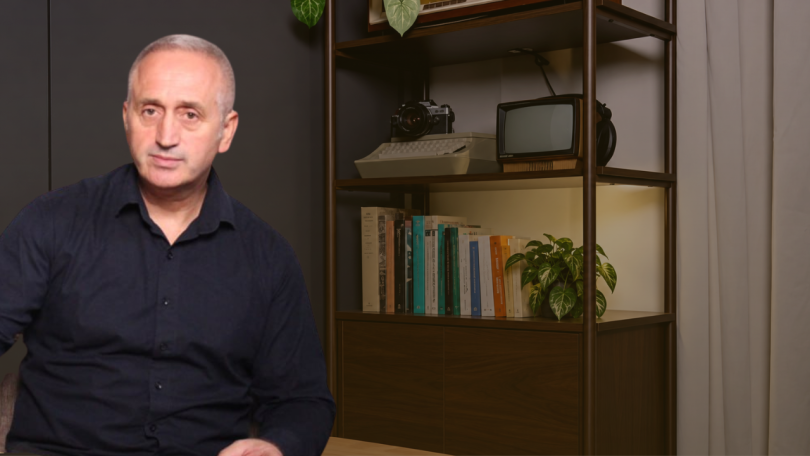
How were the relics of Saint Bosiljka discovered? What have the people of Pasjane preserved in their accounts of her martyrdom, and why does her life continue to raise important questions for each of us today? These were some of the topics discussed by Professor Saša Filipović, one of the people involved in the discovery of the saint’s relics, in the podcast “How Is It Down There?”.
Professor Saša Filipović, born in Veliko Ropotovo, has built his professional career between Kosovo and Metohija and Belgrade. Although he continued his education and work far from his home village, he says he has never thought of himself as someone who left it behind.
I come back to my own home, and I enjoy it. I look forward to every visit, and every time I return, I feel renewed.
These were his words as he spoke about returning to his family home.
In his conversation with Marija Vasić, topics such as family, education, art and the preservation of cultural heritage were explored. However, a special place in the discussion was given to the story of the discovery of the relics of Saint Bosiljka of Pasjane.
A Tradition Preserved Among the People
While researching and working to restore church heritage, Professor Filipović came across accounts of Saint Bosiljka. Stories passed down by the people of Pasjane, historical records and artistic depictions of the saint gradually raised questions about her martyrdom and the place where her relics had rested.
One particularly important depiction showed Saint Bosiljka dressed in traditional folk clothing, with a halo around her head, alongside artistic representations of her martyrdom.
Although people had known about Bosiljka and spoken of her for generations, many details had survived only through oral tradition. Accounts by travel writers, including Todor Stanković and Grigorije Božović, raised new questions but did not provide all the answers.
The Moment When Assumptions Became a Discovery
With the blessing of Bishop Ilarion, an investigation began at the site believed to contain the relics of Saint Bosiljka.
Professor Filipović recalled how, with the help of local residents and an endoscopic camera, they attempted to look inside the masonry structure. The first attempts were unsuccessful. However, thanks to their persistence and the assistance of everyone involved in the investigation, the camera eventually managed to reach further inside.
That was when images of skeletal remains appeared on the screen. The photographs were sent to Bishop Ilarion, and arrangements for the discovery and uncovering of the relics were made shortly afterwards.
It was truly a special and sacred moment, something you may experience once in a lifetime, if ever. It was a great blessing for me and everyone else involved.
Professor Filipović recalled the experience.
Describing the moment when the site was opened, he spoke about the careful removal of the bricks and the remarkable sight that greeted those present.
The first thing Metropolitan Teodosije and I saw was a skull resting on top of Saint Bosiljka’s carefully arranged bones.
A Single Choice That Speaks Across the Centurie
Although the story of the discovery of the relics is a precious historical testimony, Professor Filipović believes that the message of Saint Bosiljka’s life reaches far beyond the historical event itself.
Speaking about her youth, martyrdom and refusal to renounce her faith, he reminded us of the strength behind the choice made by a girl who was only seventeen years old.
For him, her determination is a testament to deeply rooted faith, but also a message to people today: the choices we make every day shape our lives.
One moment and one choice in favour of truth can determine the future life of each of us.
He also recognises in this the very essence of the Kosovo Covenant. As he explains, Saint Bosiljka’s story is not only about suffering and the past, but also about the responsibility to defend truth, faith and our values with our own lives.
Kosovo and Metohija as a Place of Creativity and Inspiration
The conversation also explored questions of education, art and our responsibility towards the places we come from. Professor Filipović recalled his student years in Pristina, the cultural life created by young people at the time, and the importance of today’s University of Pristina, temporarily based in Kosovska Mitrovica.
Speaking about young people, he emphasised that studying and creating in Kosovo and Metohija can be a valuable experience, not only in terms of education but also in spiritual and cultural identity.
Through the story of Saint Bosiljka, Professor Saša Filipović reminded us that cultural and spiritual heritage is preserved not only in books, museums and churches. It lives on through the people who know it, research it, bear witness to it and pass it on to future generations.
Watch the full conversation with Professor Saša Filipović in the podcast. “How is it down there”.
You can support our work in the following ways:
Monthly (fixed) subscription
Support our initiatives and help families in Kosovo and Metohija! We invite you to join us in the struggle for a dignified life for Serbs in Kosovo and Metohija.
Choose a monthly subscription and become part of our ongoing, day-to-day mission of support. Subscribe
One-time donation
If you would like to support our work without the commitment of a monthly subscription, you can make a one-time donation and directly assist our initiatives.. DONATIONS












Оставите коментар