


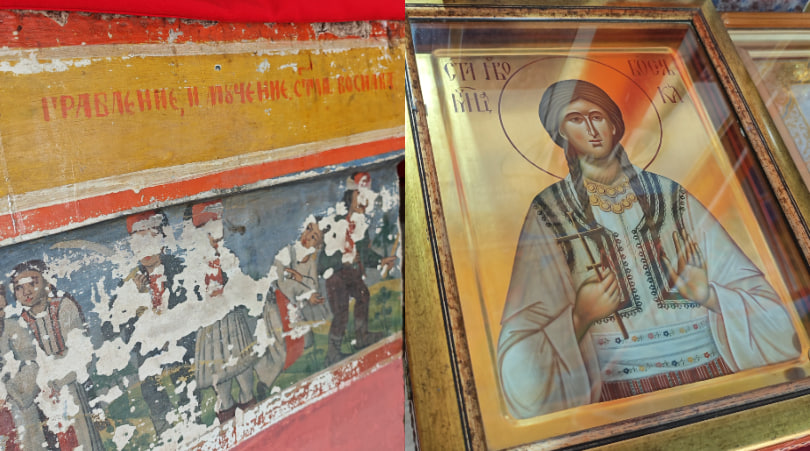
My Father used to come to church as a child, and his grandmother would tell him exactly who was who in the fresco
The Serbian people, blessed with many saints intercessors before the Lord—have always passed down great and often tragic events, most often through oral tradition. From these stories, over the centuries, remarkable individuals from our people have stood out, their names written into eternity.
The name of Bosiljka Rajčić brought honor and a sense of eternal remembrance to a small village in the southeast of Kosovo, where Orthodox Serbs have lived since ancient times. According to written traces, the village of Pasjane, near Gnjilane, is first mentioned locals say in the Charter of Princess Milica. Later Ottoman records from the 15th century also speak of a Serbian village led by a priest. However, what would forever mark the history of Pasjane is the kidnapping of the young girl Bosiljka Rajčić in the second half of the 19th century.
The abduction of Saint Bosiljka
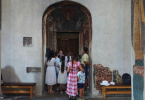
It is extremely rare to hear that someone personally knew and remembered the people depicted in old frescoes. The abduction or seizure of Saint Bosiljka is painted on one of the pillars of the Church of the Transfiguration in Pasjane. The pillar bearing the fresco was later enclosed within the church to preserve and conceal the saint’s relics. The wise clergy and faithful people of that time left behind a vivid testimony of a terrible event, but also of the unbreakable faith of the young girl Bosiljka.
“When my father was a child, he used to come to the church, and his grandmother would tell him exactly who was who in the fresco. The fresco depicts her kidnapping and ascension. So my grandmother knew and would say this is this person, that is that person the Albanians from the village of Debce. We more or less knew that the relics were there in that pillar because the frescoes were there.”
The martyrdom of Saint Bosiljka
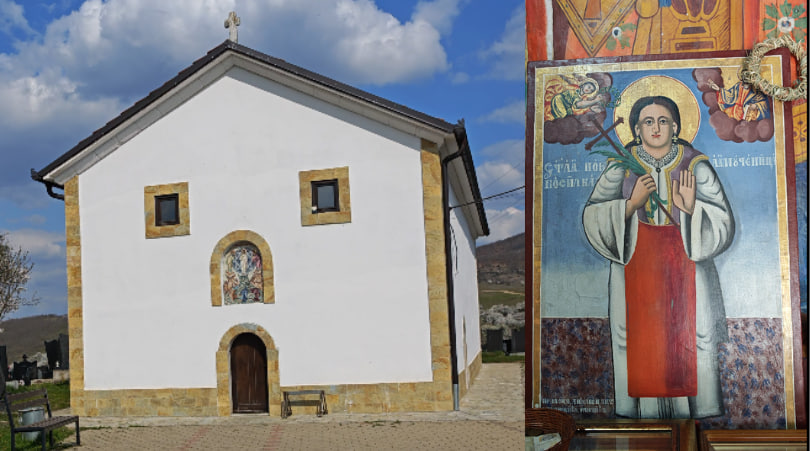
Црква и икона Свете Босиљке Пасјанске
Bosiljka Rajčić, a beautiful, modest, and devout seventeen-year-old girl, was working in the fields with her father and brothers when men from the village of Debce noticed her. According to tradition, they abducted her after firing at her father and brothers.
They tried to force her to convert to Islam, using various tricks and threats. To persuade her, they even brought an older woman who had converted, who spoke of her comfortable life and healthy children.
Yet the young Christian Bosiljka’s response was always the same:
“Christ is my chosen one—I will not renounce my faith.”
It is believed that Saint Bosiljka suffered one of the most brutal forms of death, particularly characteristic of the period of Ottoman rule. The young girl was torn apart by horses. Her body was buried on a hill above the village, due to a ban on proper burial. Later, it was moved to the cemetery, and even then it was believed to be holy.
On the eve of World War I, her relics were placed within a pillar of the church. Since the pillars were later reinforced, it is assumed they were built with the intention of hiding and protecting the relics.
“During the transfer of the relics to the cemetery, the priest at the time concluded that these were indeed the relics of a saint, due to their distinctive golden-yellow color. They looked as if made of wax and clearly differed from other bones found during the excavation,” explained Petar Cvetković, a resident of Pasjane and a witness to the discovery.
The discovery of the Relics
With the blessing of Bishop Teodosije of Raška and Prizren and the then abbot of the Draganac Monastery, Father Ilarion, the discovery of the relics of Saint Bosiljka was carried out on October 23, 2019. This unique event was preceded by months of research conducted by Professor Saša M. Filipović, then a full professor at the Faculty of Contemporary Arts in Belgrade.
The icon depicting the Abduction of Saint Bosiljka was one of the key signs that led to the discovery of her relics. Her feast day is celebrated on October 26.
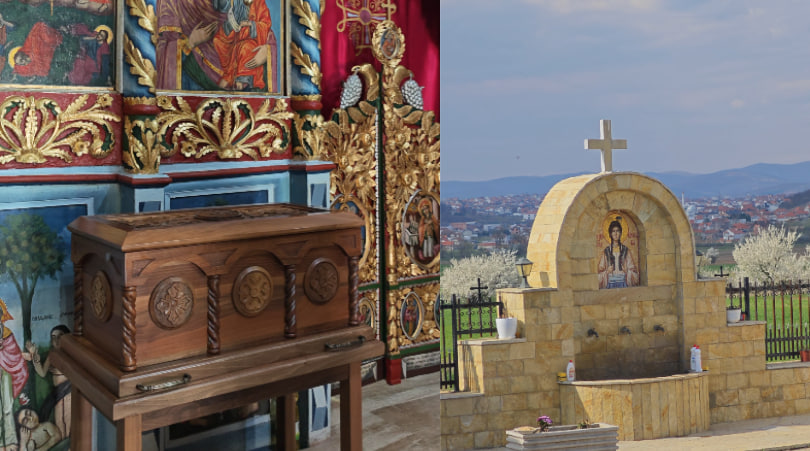
The relics of Saint Basil of Pasjan and the fountain with the icon in the church yard













Оставите коментар