Green stretches as far as the eye can see on both sides of the Gnjilane–Pristina highway. Field after field, blade after blade of grass, endlessly reaching toward the sky. I wonder which of them is sacred, which is stained with blood—that is Kosovo. Rising from one field stands a monument, pointing skyward without a cross or dome, more a reminder of what should have been than a testament that these fields are not meadows but graves, that the grass is a wreath, not a flower, that Kosovo is not Serbian land—but heaven.
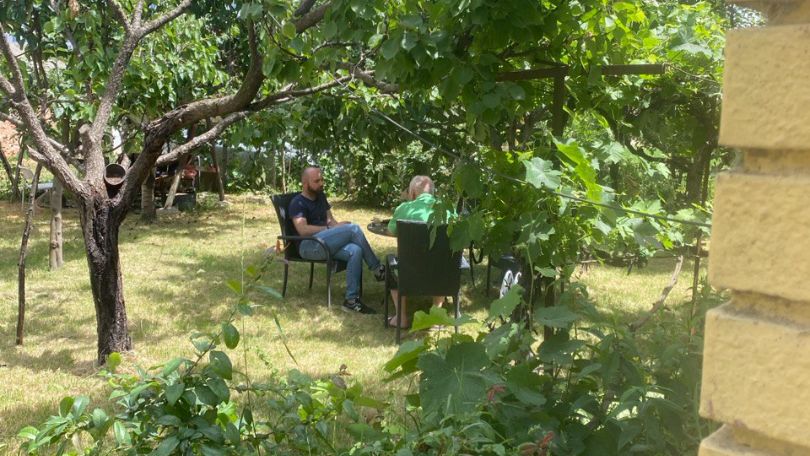
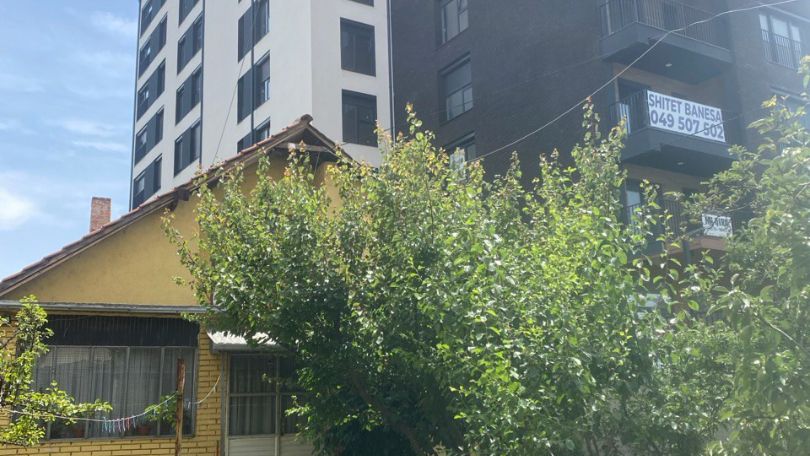
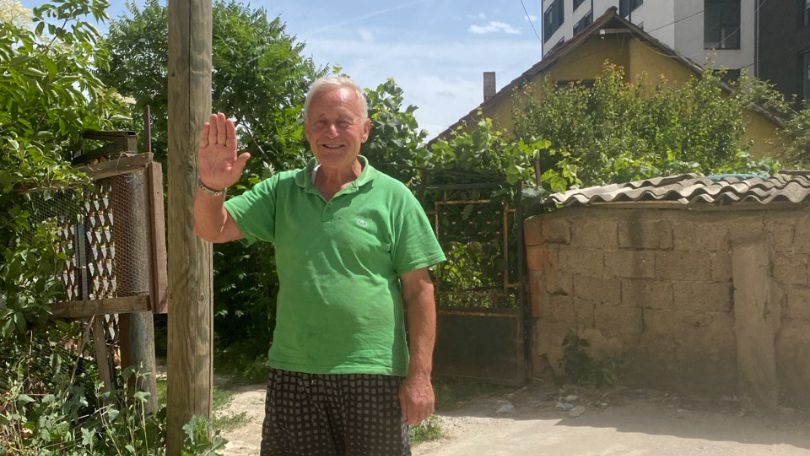
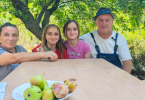
In some mythical, festive daze, on Spasovdan in the year of our Lord 2024, we enter through an iron gate into the Mitrović family yard, in what was once the village of Bresje, now merged with the small town of Kosovo Polje. From the road, no one would imagine that in the heart of this newly built neighborhood, among ten-story buildings, parks, sidewalks, and bakeries, sits a small yellow house, hunched as if pressed by the shade of a high-rise. Inside, Serbian resident Momir Mitrović, known as Vlada, lives in a village that no longer exists.
-My house is not for sale! No, it isn’t. That’s how my wife and I agreed. I asked my son—he said no too. So my wife didn’t allow this house to be sold. Yes, it’s my inheritance, but we worked on it together for over 40 years. I wouldn’t go against her, even if I wanted to sell it. Once, I just asked, because I see everyone around us leaving, selling, and I wondered, aren’t we going to be left here alone, what do you think, Sonja? My house is not for sale—end of story. That’s what she said, and it’s stayed that way. Some people say, ‘It’s mine, I’ll sell it’—it’s not yours, you inherited it, and you owe it to someone. Mine is only what I earned myself.
A smile, full of longing and memories, draws in the cigarette smoke lingering in his mouth, quietly, while the construction noise echoes in the background.
-Cheers! Welcome to me! I have no one to spend time with. The few people left either drink or waste their time. I go to Ugljare—there you just sit and hear who sold a house and how much. I don’t fill my head with that. People just talk about sales and profits—I don’t care. Then I go toward Prilužje—a huge village, second largest in Kosovo, and empty. When I see Prilužje like this, what more is there to say… The only thing that bothers me is loneliness, I’m not used to it. But I can’t go anywhere. I don’t like pity. Whoever comes and says ‘Oh Vlado, I feel sorry for you,’ I immediately say, don’t pity me. I have people to pity me if needed. Otherwise, nobody should pity me. I’m here not because I have nowhere to go, but because I want to be here.
Once, there were fifty Mitrović houses—plot after plot, stretching from this yard toward Kosovo Polje. Today, only two remain, with two residents inside, plus neighbor Šilja, a small garden, and an empty patch of land. Around that piece, says Uncle Vlada, former Serbian neighbors who no longer live there still keep watch, always aware of sales and prices, to which he always responds, “More. More!”
-When I went to the car market to buy a car, I met an Albanian who said someone offered him one and a half million euros for a field. I asked if he’d sell it, and he said no, neighbor, this is land, and money is paper—land isn’t sold for paper. Our Serbs seem to have forgotten that. One Albanian told me, ‘You Serbs gave us your land for free, Americans and Europeans never will, and we sold it ten times more.’ I don’t know… we started competing over who would sell. Where else could I live to sell this? Who’s waiting for better than this? But then you see the director sold, the politician sold, so the poor guy sells too to save himself.
Windows of the house are barred, flowers behind the bars. Occasionally a bird may visit—childhood things. Almost no one from before the war remains in this part of Kosovo Polje, as if new people moved in. Contact between new residents and Serbs is minimal. Older times—the so-called Serbian times in Kosovo and Metohija—are remembered fondly by locals.
-When all this started around us… we were calm, knowing we couldn’t change anything. Every day, noise, hammering, machines, construction—driving us crazy. We had to endure it, by God. But it passed. My son often gets upset now, asking why I sit here alone, two and a half years since my wife passed. I just got back from Belgrade after a month, I can’t live there. Somehow, the closer I get to Kosovo, the easier it feels.
Serbs rarely return to or visit Kosovo Polje. The fertile Kosovo plain, easy to work, was never fully appreciated as a treasure. Many have assigned it a price lower than buyers could imagine.
-Kosovo Polje had ninety percent Serbs, almost everyone. And it left the fastest, maybe in a year. The first to sell were those who pretended to be the biggest Serbs—au, au, au—and at the first crisis, they sold. Now they talk somewhere in Serbia. One Albanian told me, ‘We thought Serbs wouldn’t give up Kosovo Polje, there would be a big fight.’ But it went first and for free. Imagine how it hurt me to hear that. Then, when I saw people buying Serbian houses, walking in as if it were theirs… I know some got huge sums, but happiness isn’t in that money, I swear. Selling Kosovo land is hard, very hard. It doesn’t last. For anyone.
Not everything has been sold yet, but little is not for sale—through Ugljare and other villages toward Gnjilane. Where is Kosovo Polje today? The question hovers in the heavy summer air, under the Spasovdan sun and dust from the fresh ruins of yet another sold Serbian house. Each of us seems to have inherited a piece of Kosovo Polje. Some sold, some gave up their inheritance. But one thing remains—locked away, in a small yard, in front of the house under a cherry tree, along the narrow path to the ruins of a brother’s house, flowers in the window longing for the hand that planted them, in eyes shedding tears at parting before they can even speak the name engraved on a cross, in a Belgrade cemetery, where rests the wife of a warrior from an old time. This is our Kosovo Polje, a battle that never ends. Today, and for centuries.
Before Vidovdan, 2024.
Marija Vasić