
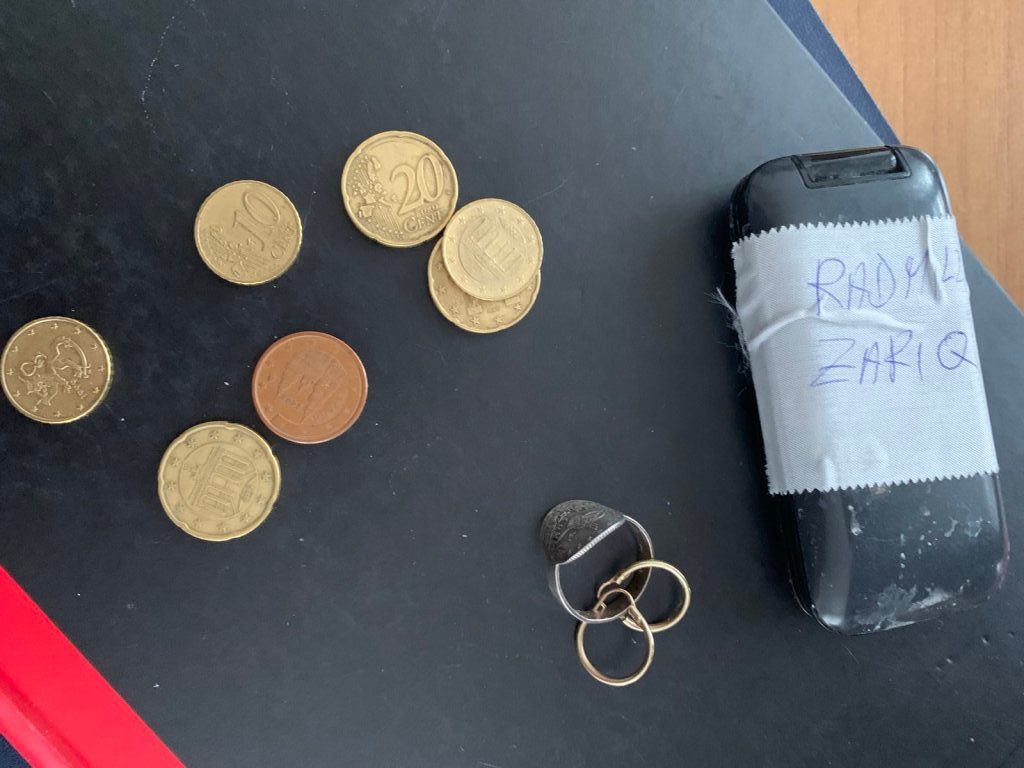
So, what will remain of the last Serbian woman in Pristina? Small, round earrings attached to a costume jewelry ring; 95 cents, in metal; a broken phone, taped up, with the name RADMILA ZARIQ printed in Latin letters. And that last letter Q, stretched –ći, like an arrow buried in the body, will be covered by earth and snow. And another star will shine again, in the endless night of secret centuries, above us. And it will rush, through this valley, to lay upon our chests, once more, that word wrestled with for centuries: Kosovo
Listen, you living ones, as time slips by, if you think you will never hear the silence of our dead: the air of Kosovo has long been stifled by the thin whip of unfulfilled promises! For centuries, the icy wind of great unrest has mocked it cruelly!
And the pale Harvester silently shapes great stacks.
And piles graves upon graves.
And I watch (led away, waiting for the first snow) as our dead still fly across these empty fields, like dry leaves.
And tears, dry and bare, irrigate, drop by drop, the furrows of old suffering. Within them, the last hours of Radmila Zarić will remain forever, hidden and austere, hovering like smoke around a quiet hearth.
In a cramped room at the Old People’s Home in Pristina, on December 11, 2020, her motionless body slowly changed color. She extended her right hand, sinewy and dry, into the distance, to meet her left hand, which would guide her from field to field. Her soul, pressed against the wings of the wind like an airy garment, ascended. A slow, cold cloud aided her transformation. Distance is not great between a cloud and a person, she told her unborn daughter. That curve of distance, seen perhaps only by her eye, she sent as a message in a bottle to the world that December night, across hamlets, streams, and watering places of her youth, through bushes and thick undergrowth, through secret springs and swollen underground waters. Carried by angels, it would adorn our shoulders for days and nights like wings. One day, she said, it must be known how Radmila Zarić, as Radmila Zariq, quietly departed from her last room, where the air temperature had come to match that of her abandoned body.
And she left her eyes closed.
For she had seen everything here on earth.
She thought it better to take with her the suffering, the secret, and the cry into the great celestial anthill.
Her hands, for eight long decades, named the sun and the cool day. Time is. Enough. Too much.
Clear eyes from the Montenegrin rocks eventually settled in Goraždevac, gazing dimly, farther and farther. Beyond the glass of water on the table, where a sugar cube melted. Beyond the half-cut apple yellowing on the tin tray for five days. Beyond the stale newspapers she could not read without glasses.
Old age lays one down like an executioner from behind, she thought, wishing only that she might not fall to her knees, but if she must fall, to stretch her whole body toward the earth and face the sky. And small joys (there were some, yes, there were) should then dissolve quickly in the height. Snow-laden clouds should drop their flakes like hopping sheep across the wide, flat fields of Kosovo.
And so, the blow of death came, like a dream. Into a dream. And Radmila sank into the most healing pebble that could separate her from reality.
A blend of night whiteness, softer than the clouds she could climb and whiter than the unspilled milk of this childless woman’s breast, led Radmila Zarić to the heavenly river. Through the spread Milky Way, it all quickly became a great, solitary silence.
The grave was dug by workers from the Municipal Enterprise Ecology in Pristina.
Mrs. Vezire Ćazimi from social services prepared the deceased for burial.
Mr. Idriz Đigoli from the Islamic Community provided the coffin and transport from the chapel of the Old People’s Home to the Pristina Orthodox cemetery.
Sister Slađana Aritonović from Gračanica prepared wheat and wine for the soul of the deceased.
The funeral service was conducted by Pristina priest Stanisha Arsić.
“We are all dead,” shouted the poet through frozen bones – “we just bury ourselves in order!”
And so, in the end, everyone remains alone.
And death always waters even the deepest paths of life. (The daily newspapers do not know this, stretching this quiet death out like an old rickety boat along the way. Yet again: along the way.)
Snow fell. The earth settled. And everything was forgotten.
And then, the next year, on All Souls’ Day, the delicate nerve of a woman, in noble silence at a quiet Kosovar cemetery, told me that only love can revive and free. It makes the old new.
I sit on a bench beside my aunt’s grave, on the clearing in Drenovac, with a breeze that cannot be seen or heard. The bones of the dead here climb mountains for centuries; their dreams paint the valleys blue. From this shoreless hovering, their shadows descend along the gentle Morava slopes to feast. To their cheerful, colorful graves.
And I think how a single loaf of bread nourishes millions of souls. And how only in eternity there is no hunger, no distance, no separation.
My aunt was small. Childless. Rugged. A fierce worker, I say. She spent years, pinned to clay, like a wild deer in a nest.
I dip my hands into the earth and into black coffee, stirring in white sugar cubes. For my aunt. For Radmila. And I watch them melt, like ice cubes in hot tea. I name my heavenly tenants. I dedicate. I light a cigarette and pierce it like a thin twig into the ground. Women around the grave share candy, pastries, and cream cakes. Already dry and cracked crosses draped in faded cloth are sprinkled with brandy and wine.
And we are all nourished like this land.
And we keep melting into the soft wind of Old Serbia.
Like that sugar in my coffee.
In the sweetness of its dialect.
Before which death seems small.
And life – immense.
So, what will remain after us? Our ornaments, money, tools, letters of our name? Our tears, warm like rain, or our soul, full of fragrance? Hands that plowed the earth, or hands that reached for the sky? Perhaps, only that single, even day, between body and air, where there was no distance between man and cloud. That moment when we soared, tiny, into the vast sky. Lighter than a song.
****
Radmila Zarić (1940–2020). Vechnaya Pamyat.
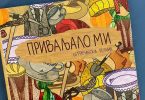
(From the book by Dušica M. Filipović, Metohijski sfumato, in preparation)