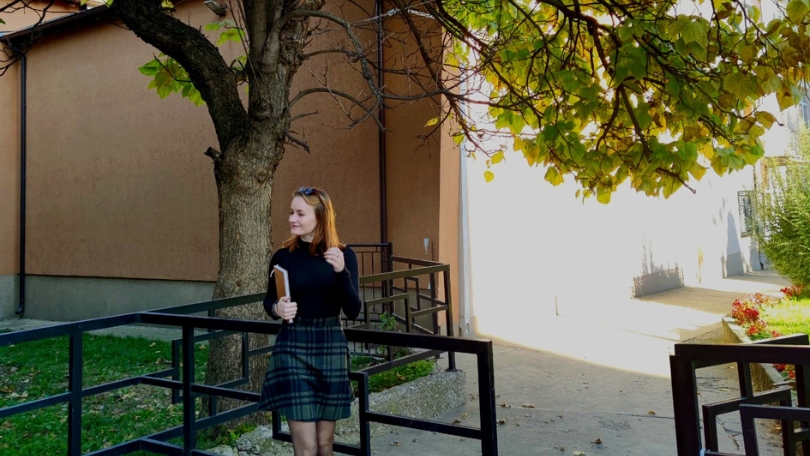
Millions have been displaced across the world, searching for a place to call their own, hoping that one day, maybe, it will truly feel like home. This has been the fate of Serbs from Kosovo and Metohija for centuries—an ongoing journey of displacement and return, circling like birds over every Serbian home. Believing, in true Christian faith, that fate is not predetermined but that God’s providence guides a person to meaning—home—Marta Dašić returned to post-war desolation, to the ruined lands of Metohija, in Brestovik near Peć. She decided to follow her parents’ example and enrolled in literature studies in Kosovska Mitrovica, Kosovo and Metohija.
-My family was displaced to central Serbia in 1999, where I was born. We lived as tenants for a few years until my father decided it was time to return, to the homeland of his forefathers. We wanted to grow up where our parents grew up. It was scary, and my parents took a big risk returning with two small children. But I’m glad they did.
Fortunately, Marta and her brother were children, she recalls. They were completely unaware of their surroundings and hardships, growing up carefree in the village, inventing games and letting their imagination roam.
-We didn’t have what other children had, but we were happy, and I’m grateful to my parents for that—only home can give you that.
Why would someone choose to study Serbian language and literature when most young people today are drawn to fields that are well-paid and offer easy job prospects?
-Most young people today choose something that brings a high income and a clear career path—you can’t blame them, that’s the reality. I personally chose literature because I love language, especially literature, and I want to contribute to preserving the Serbian language in these lands. Language is incredibly important to us, as it’s part of our identity and tradition, which we safeguard through language.
Marta sees herself living in Kosovo and Metohija after her studies. She can easily imagine such a life and dreams about it. Yet, the reality is that many young Serbs will not be able to fulfill this desire. Seeking work, even after surviving the war, and following the total economic collapse post-war, Serbs leave Kosovo and Metohija daily, as 25 years later, opportunities to stay have not improved. This has also changed the landscape of studying in Kosovo and Metohija compared to previous decades.
-Studying in Kosovska Mitrovica has both advantages and disadvantages. I consider myself fortunate to have spent several wonderful years here during my studies, gaining many acquaintances and cherished memories. However, the atmosphere is tense, and student numbers are decreasing every year. Due to personal fears or lack of information about life here, it’s hard for students to decide to enroll. The small student population, uncertainty, limited opportunities for young people, and lack of practical experiences make studying more challenging.
For several months, Marta Dašić has been a scholarship recipien of our organization, supported generously by donors worldwide. Such support provides hope and help to families educating children in Kosovo and Metohija, Marta explained.
-I believe it is extremely important to support young people in Kosovo and Metohija, as they are our guardians and our future. If we lose them, we lose everything! Unfortunately, our voices are rarely heard, but students should have opportunities to express their opinions.
Call to Donors
We invite donors to support our scholarship program and help educate young people in Kosovo and Metohija!
Learn more about the program: Scholarship Program for Students