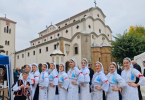
In Kosovo Pomoravlje, which largely consists of the ancient districts of Upper Morava, Izmornik (Lower Morava), and Kriva Reka lands brought into the Serbian state by Grand Prince Stefan Nemanja—today lives the majority of the remaining Serbian population of the holy and suffering Kosovo and Metohija. Their lives, and the lives of their ancestors, are worthy of long and detailed narratives, but they can also be summed up in two words: martyrdom and suffering. These two notions, with all the weight they carry, have been the constants of the centuries-long history of Serbs in these deeply afflicted regions. If we were to turn these notions into living images that reflect the life of Serbs in Kosovo Pomoravlje, we would find the icons of the Holy New Martyr Bosiljka of Pasjane and Saint Prince Lazar two saints of the Serbian Orthodox Church who came from these lands.
The life of Serbs here has always been closely tied to the saintly nature of martyrs and sufferers, while the saints remain their comforters, protectors, and sources of strength and encouragement. Saint Prince Lazar, who gained both the royal crown and the halo of sainthood by ascending to heaven as a warrior of Christ through his martyrdom, was born in the town of Prilepac, near Novo Brdo the largest mining center of medieval Serbia in the district of Kriva Reka.
The town of Prilepac was the hereditary estate of Lazar’s father, Pribac. Here Lazar spent his childhood, raised by his parents in the Christian faith, before arriving at the court of Emperor Stefan Dušan, where he was given the honor of serving as his cupbearer. Later, becoming the most powerful regional lord, Lazar built in his homeland a monastery dedicated to the Holy Archangels Michael and Gabriel. The monastery, first mentioned in the founding charter of Ravanica Monastery in 1381, is known as Draganac, named after Lazar’s second daughter, Dragana. To this day, the Monastery of Draganac is the greatest sanctuary and source of spiritual life, strength, and renewal for the remaining Serbian population of Kosovo Pomoravlje. The faithful guard their holy inheritance, and the monastery guards them in return, preserving them from destruction.
The Holy New Martyr Bosiljka of Pasjane was born in the village of Pasjane near Gnjilane, into the Rajčić family. According to tradition and her hagiography, at the age of seventeen she was kidnapped in the forest near Beli Kamen in the Stružina region, while gathering firewood with her father and brother. A man from the nearby village of Depce, near Preševo, had set his sights on her. Bosiljka shared the bitter fate of many Serbian girls in these troubled times of the 19th century. She was forced into attempts at marriage and pressured to convert to Islam, enduring constant humiliation, threats, and abuse. Yet, determined to defend her faith and name, she resisted all tortures. When even the cruelest forms of torment could not break her faith in Christ, her enraged abductor murdered her in a meadow by the Lapashtica River, brutally mutilating her body. Her remains were buried next to the village church and later built into the walls of a new church. Soon after, the people began to venerate her, creating the cult of a martyr a “hero of the people and faith”—who gave her life for her people.
In 2018, Bosiljka of Pasjane was officially canonized, and her martyrdom was acknowledged as holy, making her a shining example and a protector of her people. The lives of these two saints not only recount their struggles and witness to faith but also reflect the entire history of the Serbs of Kosovo Pomoravlje. They strengthen our belief that, in the words of Saint Prince Lazar, “God will surely show mercy upon our remnant and will not destroy completely our people and our land.” After all, without martyrdom and suffering, there can be no resurrection.
Đorđe Nikolić, Faculty of Philosophy, Belgrade