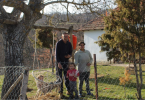

Father Trajko is the only Serb living with his family in Uroševac. In this town, the church and the mosque stand in the same yard, and the imam and the priest are good friends. Sadly, the church is almost always empty, with only the priest and his family attending services.
Uroševac, Kosovo and Metohija
In Uroševac, a city in Kosovo and Metohija where you can hardly hear the Serbian language, life as a Serb is far from easy. Still, one of Father Trajko’s few friends, whom he gained during six years of living here, is the imam of the local mosque. He says this is a man who has often been there for him and someone he can truly rely on.
“The very fact that we share the same grounds obliges us to maintain interfaith relations on a high level. We respect each other. We visit them for Bajram, they come to us for Christmas and Easter. We have a very beautiful and respectful relationship.”
And yet, wearing a cassock in Uroševac is still impossible. The priest’s children do not play outside their home, and the nearest Serbian school is more than 20 kilometers away. Today, 22 years after the war, not a single one of the 13,000 expelled Serbs has returned here.
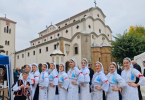
The Cathedral Church in Uroševac
“This church longs for people. For the icons to weep from the presence of many faithful,” says our young priest.
On Sundays and feast days, the church remains empty. People from nearby villages come to the town to trade but not to attend the service. Despite this, Father Trajko believes that Saint Uroš protects his family, just as they protect the church dedicated to him.
The church itself is relatively new, built between 1928 and 1933. It was consecrated on September 11, on the feast of the Beheading of Saint John the Baptist, which also became the date of its parish gathering. Modeled after the Gračanica Monastery, it was built with five domes and designed by the famous architect Josif Mihajlović.


Like many other sacred places in Kosovo and Metohija, the church was desecrated by Albanian extremists—first in 1999, again in 2000 when smoke explosives were thrown inside, and once more during the March Pogrom of 2004.
Much still needs to be done to restore and improve the interior. Father Trajko believes this is a duty we all share as descendants of the Nemanjić family from Nerodimlje. But he also knows he cannot do it alone—he needs all of us, people of goodwill, to help preserve both the church and the Serbian presence here.
If you are able, please support our work and help the Serbian community remain in Kosovo and Metohija!
DONATIONS
If you wish, you can make a donation in dinars to:
Commercial bank account (Dinars):
205-266929-36
Intesa bank account (Dinars):
160-6000000743964-30
Instructions for international donations:
https://www.kosovskopomoravlje.org/wp-content/uploads/2020/06/PAYMENT_ORDERS_IN_EUR.pdf
Donations via PayPal
https://www.paypal.com/paypalme/kosovskopomoravlje
Humanitarian Organization Kosovsko Pomoravlje
Kralja Petra bb, Parteš
Gnjilane