Parteš Village – Where the pumpkin grew, there it grew
2. October 2025.
If you happen to travel through Kosovo Pomoravlje on the road connecting Gjilan and Uroševac, you will inevitably reach a hill where the tall bell tower and yellow dome of a church come into view. Before you lies the Serbian village of Parteš, home to the Church of the Holy Trinity, nestled in the valley of the Binačka Morava River. Located seven kilometers from Gjilan, between two hills, Partesh is surrounded in summer by wheat fields and green pastures, warmly welcoming and bidding farewell to travelers passing through.
The name Parteš is first mentioned in the Middle Ages during the time of Prince Lazar as Parteš Kladenac and appears in Ottoman records. Later, likely due to Turkish and Albanian oppression, the village was depopulated, only to be resettled by Serbs in the 19th century. Historical traces remain, including the church foundations and stone cross monuments on the hill called Glavačica, standing resilient through time.
This hill, about one kilometer southeast of the village, rises to 525 meters and offers a panoramic view of Parteš and the large meadow south of the village where the Binačka Morava meanders. On the hill, you can find the foundation of the demolished Church of the Holy Savior, while at its foot lies the famous mineral water spring Kladenac.
Today, Parteš is a Serbian village with around 360 households and just over a thousand residents. Unfortunately, the war has caused significant social disruption. Industry, once thriving in this part of Kosovo Pomoravlje, no longer exists. Many businesses have closed or been taken over, leaving thousands without work or opportunities for normal life. Daily war events forced people from their homes. In these difficult conditions, nearly a quarter of the population left, leaving many homes empty.
For many, agriculture and craftsmanship remain the main sources of income and livelihood. For centuries, farming and skilled labor have sustained Serbian families in Kosovo and Metohija. Despite the economic challenges, these skills hold the key to development and the survival of the Serbian people.
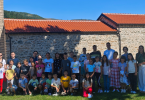
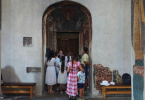
The church has long been the cornerstone of Serbian survival and the main gathering place for the Orthodox community. The impressive Church of the Holy Trinity graces the center of the village. Besides the church, Parteš also has a primary school, a clinic, several satellite high school branches, and branches of state institutions.
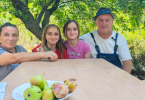
However, the true jewel of Partesh is its people. Their desire to survive and stay is evident everywhere: “in the calloused hands of the farmers, the sweaty brows of the mowers, the eyes of a proud mother, the wide smile of a schoolchild, the lined face of an elder, and the candle burning in the church.”
So, don’t be surprised if, when asked “Why are you still here?”, you hear: “Where the pumpkin has grown, it has stayed.” Inspired by this spirit and to support those who remain in Kosovo Pomoravlje, the Kosovo Pomoravlje Humanitarian Organization was founded in Partesh.