
“If I forget you, Kosovo – my Jerusalem, may my right hand be forgotten. May my tongue cling to my throat if I do not remember you, my Metohija, if I do not set you at the beginning of my song, my psalm to the Lord, my Savior.” Bishop Atanasije Jevtić
Guided by these words, we set out for Metohija, to the Serbian villages around Istok. Why there? Because that’s where the largest number of Serbian returnees live those who left their homes during the war, together with the army, and who today are bringing back youth and life with otherworldly will, strength, and courage to remain who they are, on their own land.
As we traveled, passing ruined and abandoned houses and estates, I felt as though time here had stood still since the war. Only an occasional oak log leaning against the ruins of a once-family home, near the village of Žač, reminded us that we were not alone.
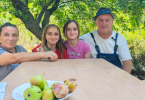
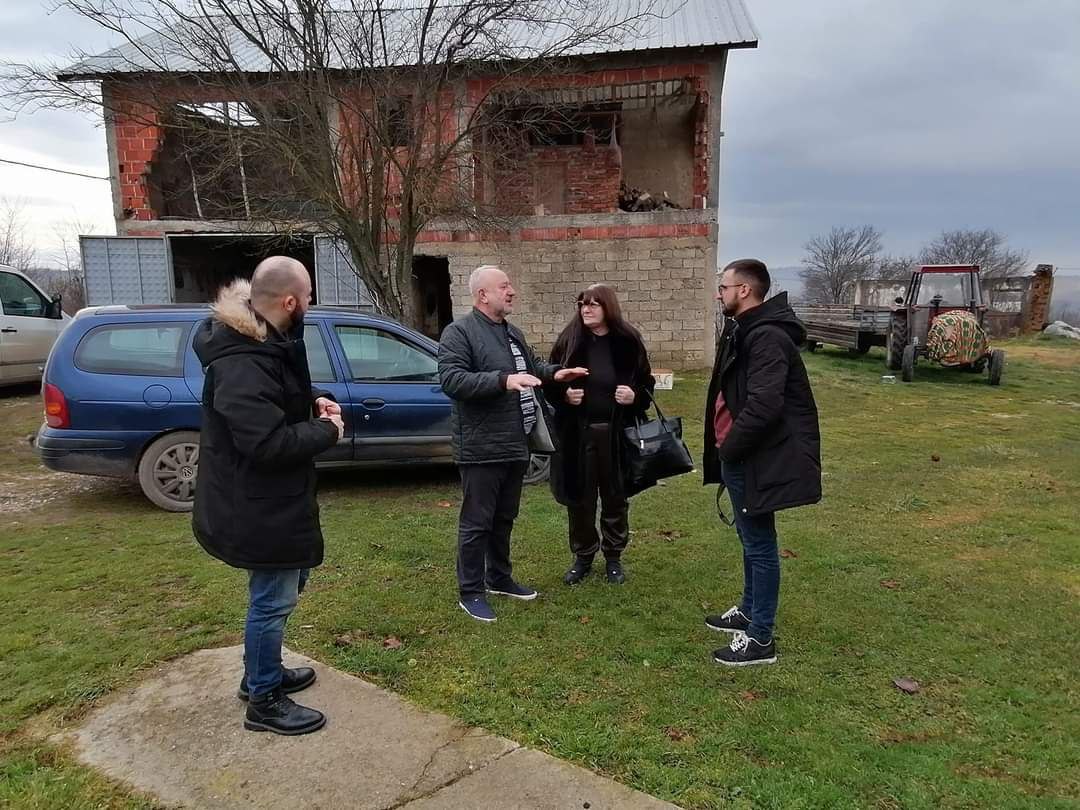
We arrived in the morning, needing coffee and a little rest. Our host, Petko Miletić from the hamlet of Oprashke near Istok, awaited us. On a rough road up the hill, we reached the only Serb living there. Petko is a single father raising his daughter Tamara and son Lazar, both high school students. They are a hardworking family, making a living from the land and their livestock there are no other options in this area. Everything they produce, with great effort, they try to sell in Kosovska Mitrovica, whenever they can get there. Still, they don’t want to leave their village. The pull of their ancestral land has always drawn them back. The Miletić family’s story is unusual. They were not born in Kosovo; the property belonged to their grandmother. Petko, while living in Belgrade, often lost sleep imagining time and weeds swallowing everything his ancestors once built. That’s why he decided to move his family to this, then distant and unknown, village in Metohija of which they had only heard stories. Yet even in those stories, they could not have imagined what it was like to be the only Serb in a village beneath the mountains, a place abandoned even by most Albanians, where conflicts and war never truly ended, where trenches remain open, and new ones are still being dug just to preserve bare life. “I’m here, and I have nowhere else to go. My children must find their own path. I do everything I can to provide what they need for school, and then it will be up to them whether they stay or leave,” says the host. Tamara dreams of studying psychology in Kosovska Mitrovica, while Lazar is passionate about programming. They admit that sometimes their dreams feel too big when faced with the harsh everyday life under Mokra Gora but that very life makes them stronger, pushing them not to give up.


A new life
We continued toward Osojane, the administrative center for the Serbian community in the Istok municipality. This village was burned and emptied of all Serbs in 1999. By August 2001, they began to return. Homes and households were rebuilt; the world watched in disbelief as a proud people, sleeping in barns by night, raised their houses from ashes by day. It was a miracle and a feat described by Serbian monks and bishops as a Gospel-like event. Today the village has a functioning elementary school with about 40 pupils and branches in nearby villages, as well as the “Saint Sava” Gymnasium for students from across the municipality.
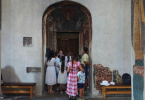
Osojane is also home to the Church of St. Nicholas. It was mined and destroyed in 1999, but after the return of the villagers, it too was rebuilt and brought back to life. Father Dalibor Kojić now serves here and welcomed us warmly. In the churchyard stands a monument to all the killed and missing people from Istok. The list is long, painful, and perhaps not even final. Each name is that of a hero and martyr of this small but defiant land.


Crkolez the heroic village
The only village in the area that withstood all attacks and attempts of expulsion is Crkolez, beneath Mokra Gora mountain. From the war, a story remains: an Albanian soldier was once asked what kind of people lived there, since they had been attacked from every side for days, yet defended themselves as if there were 10,000 of them inside instead of just a handful of Serbs. His answer was: “You don’t know them. I’ve lived with them my whole life. If they were normal, they wouldn’t still be there.” With humor and pride, the villagers of Crkolez shared this story about themselves. Even today, they remain brave and determined to defend every stone of their land, never desiring what belongs to others. That is why, they say, Albanians and everyone else in the region know and respect them despite everything.
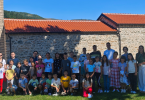
Families here are hardworking and honest, cultivating large plots of land and raising livestock. They never sold their land it has ensured their survival. Without the land, they say, there would be no them. The village has an elementary school, “Jedinstvo,” with 11 pupils. The same building also houses a small clinic enough for these modest mountain people to lead simple, fulfilling lives.
The village is protected by the Church of St. John, built in the 14th century by nobleman Radoslav (later monk John). By the century’s end, it became part of the Athonite monastery of St. Panteleimon.
In the churchyard grows a centuries-old mulberry tree, said to have been grafted from a branch taken from the Patriarchate of Peć when the church was built.
“Our church protects us, as long as we protect her,” a young villager told us as we left. Remarkably, the village is full of young families with children living proof of resilience.


Love and unity
Our last stop was Ljubožda, a village beneath Mokra Gora near Istok, where 13 families returned in 2017. This place proves that without love and unity, nothing can be achieved.
The returnees here also farm, though they often face theft and property destruction. When they leave the village for errands or doctors’ visits, their homes are broken into, leaving them with little machinery or valuables. “It was impossible to protect what we had, so we got used to living without it. Less to worry about when you own nothing, there’s nothing left to steal,” they told us with a smile, trying to lift the weight of hardship.
The people of Ljubožda are well organized, helping one another and living as a true community
Every day, they gather at someone’s home to share coffee and meals, remembering the past but also working toward the future. Together, they are restoring their village for the generations to come—rebuilding homes, cleaning cemeteries, and uncovering forgotten layers of history. The village is rich in cultural heritage. It is believed to hold one of the oldest churches in Serbia, along with an ancient cemetery still maintained by locals. The Monastery of the Holy Mother of God of Hvosno also known as Studenica Hvosnenska or Little Studenica once stood here. Today, only the foundations remain. The oldest structure is a three-aisled basilica from the 6th century, part of a fortified settlement. When the Serbian Orthodox Church became autocephalous in 1219, this monastery was chosen as the seat of the sixth diocese. A new church was built at that time.
Metohija, as its name reveals, means metoh land belonging to a monastery. Because of this, it has suffered, just as the Orthodox people living on it have suffered. To bear the Serbian and Orthodox name in Metohija has often cost life itself. Yet neither Metohija nor her people can abandon their truth. And that truth is one of innocent victims of an unjust war, without monuments or epitaphs. Still, her name is known, remembered, and will never be forgotten as long as there are Serbs with souls who know where their Metohija lies.


If you are able, please support our work and the survival of Serbs in Kosovo and Metohija!