
The hospitality establishment (abbreviated as HE) “Sveti Nikola.” Zaječar beer. Rakija. Juices. The last words written in Serbian, decades ago, remain on the door of an old tavern outside the churchyard. And two brown boxes in the window labeled in Cyrillic “coffee” and “sugar.” Everything else Serbian is located just a few meters away, behind a tilted gate topped with a cross. Here, the life of Serbs in Gnjilane has been fenced off and locked away for more than twenty years.
In front of the gate is a small market. In the afternoon, no sellers are around. Behind one empty stall sits an older man collecting parking fees in his yard, right behind the market. He knows we are Serbs because only they, when visiting, avoid parking with him.
Go ahead, turn in if it’s easier for you. The folks from the tavern are gone, done for the day. I’ll stay a bit longer. Today there’s no one; sometimes I make 2-3 euros, it means a lot to me, it’s enough, says the elderly Albanian with a smile, speaking clear Serbian, trying to say more. While we thanked him for his kindness, I felt sorry we hadn’t parked there to earn him a little extra. But also for everything else. One thought from my Nikola, spoken aloud, lingered in my mind: “Well, you wanted a republic, now you work for 2 euros, what can I do…” – I forgot that he doesn’t accept dinars.
Everyone has a different why for us outsiders who don’t remember how things used to be, whether it’s told by locals, Albanians, Serbs, Roma, or Turks. That’s why it’s hard to imagine them talking to each other, even though they know each other well and understand each other deeply.
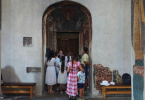
On the other side of the gate, Father Rade came toward us to welcome us and unlock the church.
-God bless, Father!
-God bless you, children! Come here, I’ll unlock it. I can’t leave it open. Children often come to take pictures at the church; I’m afraid they might go inside and, God forbid, desecrate something. They won’t, maybe not intentionally, but they don’t know, they are children…
When the father said this, I understood why two teenagers sitting at the entrance, photographing each other, didn’t return our greeting.
-Is anyone around, Father? Do people visit the church? It’s quite damaged, it needs renovation.
-No one, son. Only 18 Serbs remain here, just a few children; no one comes. We need renovation. Once we restore ourselves, restoring the church will be easy. People here lived under the Turks for centuries, fighting for their home, their faith, and now… everything scattered, everything sold, it’s not right, not good.
Some words, some because of the crumbling high walls with cracks leaking like dried tears, brought tears to my eyes. We prayed before the beautiful, large iconostasis. And before all the other golden, tall, massive, ornate, and dusty items left by wealthy Serbian merchants, church donors from Gnjilane. And before the busts of their descendants, former notable citizens, cast in iron, protected witnesses of a bygone era, hidden on the terrace where the choir no longer sings, testifying to God, praying for mercy.
Outside, everything has blossomed and thrived. Moss fills cracks in the old tombstones; water dripping from the fountain in the courtyard nourishes the flowers, while birds chirp a prayer. Many such monuments surround the church. Some still bear readable names and epitaphs, mostly priests and their wives. One stands out, specially fenced, with photos and large Cyrillic letters, as if written in a book:
“Taska and Vasa Aganić, merchants, who before the Serbian army entered Gnjilane on September 25, 1912, fell as victims of Turkish cruelty, riddled with bullets, never seeing the long-awaited Serbian freedom and consecrated Kosovo after their tormented lives under barbaric Turkish rule.”
Briefly, holding her hand, a mother entered the churchyard with her little daughter. Among all the beauty and splendor around the sanctuary, the most beautiful sight was the little hand crossing herself before washing at the fountain. A tiny Serbian girl a delicate flower, blooming on her own as if God wanted to highlight how special she is.
Tucked away and somewhat hidden, there’s a smaller gate leading from the churchyard into the school yard, or what is called that. It’s just big enough that when a larger person spreads their arms, they can touch both basketball hoops. And there’s the makeshift classroom—a container—called the Serbian school for Serbian and Roma children. It was once named “Vuk Karadžić” Primary School and located in the city center. Probably, even today, the old sign is hidden under a layer of plaster that reads: “Thimi Mitko.”
Just as the sign “Knez Lazar Gnjilane Barracks” was replaced, and the city cemetery became a Serbian cemetery that bothers investors and spoils the view from new high-rise windows.
So, the last Serbian house, right behind the church, remains to irritate, defy, and disturb, sharing the fate of its people in Kosovo and Metohija. It stands ruined, looted, with broken windows, sunken into the ground and overgrown with weeds.
Finally, a thought returns to the most painful question: Can Serbs return to themselves to return to Gnjilane? Yes. Perhaps. If they have someone to return to. If they have preserved a little of themselves. If lost pride is restored and abandoned faith revived. Maybe they can reclaim lost, scattered, and sold deeds. Everyone their own. So no one lives in a cursed courtyard, because we are all guilty of thinking none of us is.


Marija Vasić
Editor, H.O. Kosovo Pomoravlje