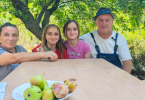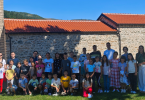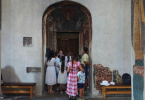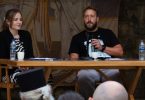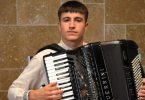
On his 50th birthday, Sladjan Jovanović from Grnčar (Vitina) was diagnosed with colon cancer. From that moment, another great life battle began for Sladjan and his family. He urgently had to go to Niš for radiation, followed by a month and a half of difficult and uncertain days. His treatment then continued at the Military Medical Academy in Belgrade. Today, two years after his surgery and with a stoma bag, Sladjan is the choreographer of the Cultural Artistic Society “Jovan Kojić” from Vrbovac near Vitina. He does it out of pure love for dance and children, without receiving any pay. For folklore, he says, he even risks his life. But for Sladjan, being alive means dancing with all his heart!
I can’t just sit when my heart wants to dance! I had surgery in March, and by June we started rehearsals. Weak, yellow after surgery, I said—I want to, I must, I love it. Because of the children. All these kids are mine, and it makes me happy that I can bring them together, keep them off the streets, away from phones, to dance, to spend time with each other…
Sladjan has dedicated his whole life to folklore and football. Since the war, he has been one of the main people preserving folklore tradition and football in the Vitina area. He even met his wife at a rehearsal, and without hesitation, married her thirty years ago. She and their children know how much everything he does means to him, though they sometimes worry about his health. Still, Sladjan has convinced everyone, even medical staff, that a person’s will to live is stronger than fear of illness.
It’s been a year since we restarted the folklore group, and during that time I never missed a single performance or rehearsal—we had about 60! When we lift an entire hall to its feet, that’s something you have to experience. I know I’ve succeeded. People usually think, oh, it’s just a group from Kosovo, nice to have them. But when they see our choreography and hear our songs, people cry. Once I went straight from chemotherapy to a concert. On the way back from Vranje, I asked the ambulance to leave me in Kusce because the kids had a performance. People were shocked. How can you, Sladjan? But I love it. The kids hug me, respect me, they know about my illness. Whenever we perform near a church or monastery, they bring me little crosses and pray for me. Sometimes I joke, telling them one day they’ll go on without me, but they immediately hug me and say: ‘No, Uncle Caki, we won’t let you go.’ That keeps me alive. I know people with my diagnosis die, but I don’t think about the illness. I only think positive, positive… and that’s how you live.
Even doctors at the Military Medical Academy agree that “Uncle Caki” regained his strength and smile through dance.
At my first check-up, the doctor told me: ‘You Kosovans don’t look like someone who’s had surgery.’ I told him I didn’t, and showed him a video of me leading a kolo at a wedding. He couldn’t believe it. He said: ‘You’re good, but you must be careful if you overdo it, you won’t make it.
Life has tried to break Sladjan’s strong and joyful spirit many times. The hardest moment was losing his five-year-old son to the same cruel illness he now battles himself. During the 1999 mobilization, he was sent home when news came that his sick child wanted to see him. He still remembers his son’s last words in his arms: “My dad, the soldier, is here!”
My first child, then war, then crisis, injustice, poverty… something had to break. Thank God He gave me two more sons and a daughter, but for a parent, losing a child is unbearable. A part of me is gone. As the years go by, my wife and I miss him even more.
After the war, like many Serbs from Kosovo and Metohija who once worked in factories, he lost his job. Later, even the right to minimal financial assistance was taken away. Until he was granted a disability pension due to illness, he had no steady income. Today, he and his family of six—including two students—live only on his pension of 16,000 dinars and half of his wife’s salary.
Before I got sick, I never asked anyone for anything. Even now I don’t—I don’t need money, I need health. Nothing I do can be measured in money. What matters is respect for my work and effort. I teach seventy children, and they all listen to me. I tell them: ‘You know my condition, I must not get upset because of you.’ And they respect that. Teachers ask me: Sladjan, what do you do with them that they are so obedient? We can’t handle even a few. I don’t know, I tell them. They love me, and I love them.
Because of lack of financial support, the founders of the folklore group had to introduce a minimal membership fee for children, which barely covers fuel for performances. For this reason, the future of folklore in the Vitina region depends on the will and strength of three people who are still working to keep the “Jovan Kojić” society alive.
We are on our own, an independent group. That’s the hardest here having no support. It’s a shame there’s not more care for these children and us, but there are good people, like this organization and individuals who see what we do.
After everything he has gone through and the injustices he still faces, Sladjan Jovanović simply says:
The hardest thing is to remain human, but no one is greater than God.


If you are able, please support our work and the survival of Serbs in Kosovo and Metohija!