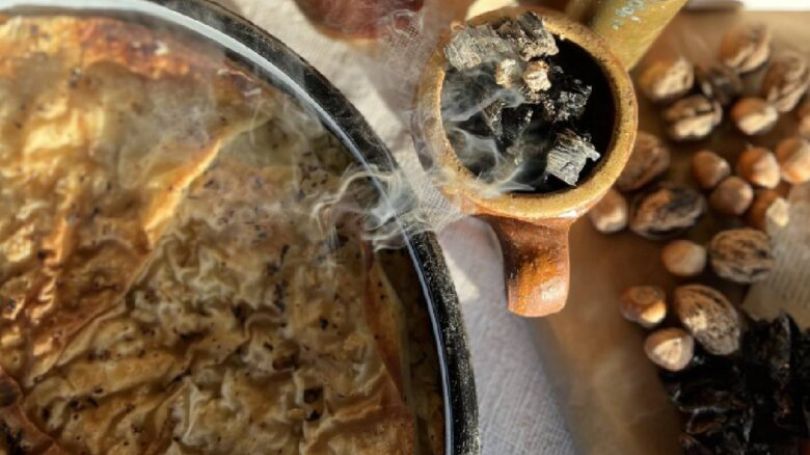
Among Serbs, it has long been a tradition to have Christmas Eve dinner on the floor, laid with straw. After the evening liturgy, the family gathers around the table, the meal is blessed with incense and prayer, and thus the Christmas fast comes to an end.
“The flour must be good and soft. Then comes water and salt. The dough has to be smooth, rolled out well — if the flour is bad, the crusts crack and tear. Just like a mother’s hands, always adding water and salt, into the dough, into the manger, into life, until they break… Each crust has to be stretched and baked on fire. This pie cannot be made on a modern stove, it must be baked on wood. When prepared well, the crusts can last up to a week. Everyone adds what they like inside.”
Rolling out homemade banica bread crusts
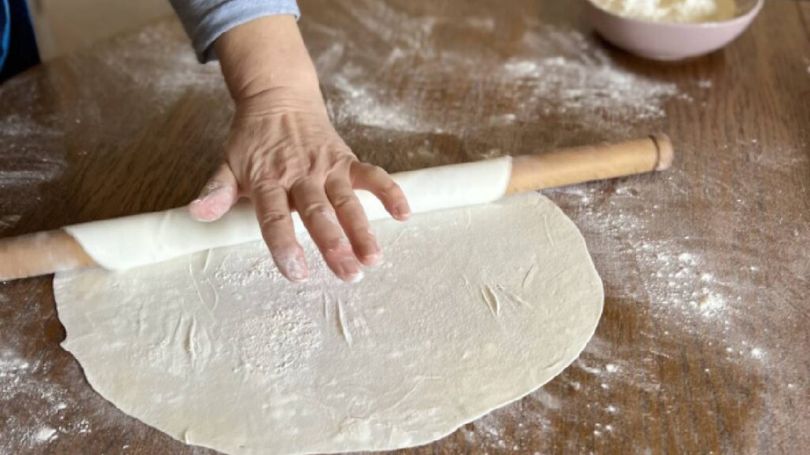
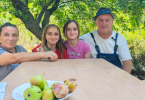
Zorica Aleksić explains that in their family the banica is made with cabbage — not fresh, but pickled and finely chopped, sautéed in oil. A few spoonfuls of this filling go between the crusts, and then everything is returned to the oven.
Zorica was born and married in Makreš, one of the oldest Serbian villages in Kosovo Pomoravlje, near the medieval monastery Draganac. Their land, embraced by forest and hidden from the main road, overlooks the golden medieval town of Novo Brdo. From the house, a long forest path stretches under young oaks, with the sky above so clear and close that at night it feels like you could pluck a star.
“We still keep everything as our elders did. I learned from my mother-in-law and mother, and I don’t change it. For Christmas Eve, we prepare fasting banica, fish, beans, peppers, fruit, walnuts, hazelnuts. The men go to the woods for the yule log, which we bring into the house before dinner. The yule log is burned for prosperity. Straw is also spread inside the house because Christ was born on straw.”
On Christmas Eve, dinner is eaten on straw. After the service, families gather at the table, bless the food, and end the fast. Early in the morning, the “polazajnik” — the first guest bringing blessings — visits each house. Sadly, in Makreš today only a few Serbian households remain. The Aleksić family no longer has a polazajnik, but they are grateful to God for having each other.
“The essence is to nurture what is lasting — the Liturgy, family, home, and bread. I learned to tie every joyful holiday to church and the Liturgy — to God Himself. Everything else, however popular, is just pagan custom to me. Christmas has no true meaning without the Liturgy. That’s why I don’t need festivals, decorations, or events. My joy is in church, my home, my family, my village.”
The strong yet gentle words of Zorica’s daughter Jovana fill the early mountain evening. When one’s soul matures under the stars of Novo Brdo, the false lights of the cities are hard to follow. Mountain villages here are quiet and dark, so people — young and old — seek only the true Light, because they themselves are its reflection.
“I wake up early to prepare everything and feed the animals. When the family wakes up, the house is blessed with incense. I usually don’t go to church — if I did, who would prepare everything? It all has to be ready, warm, so when the others return from church they can rest and enjoy. They are welcomed with roasted meat, bread, cakes. For Christmas I bake geese and ‘ralci’ — small festive breads, geese-shaped for women and cross-shaped for men — and we gift them to everyone who visits us during the holiday.”
Kosovo banica
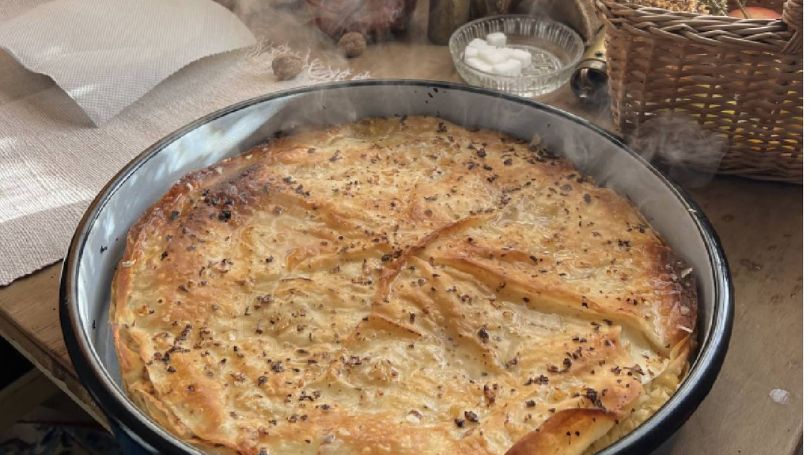
As Zorica says, Christmas Day is spent at home with the family. Only on the second and third days are guests received and visits made. More often than not, she is the one waiting, kneading, baking, and seasoning tirelessly. For our mothers, joy is in serving — and their banica is the most beautiful prayer offered to God.
Marija Vasić